
Why We Do Not Put Our Degrees on the Wall

Walk into most therapy offices and you will find a fairly predictable environment. A desk between you and the therapist. Overhead lighting. Degrees framed on the wall. A tissue box positioned precisely within reach, as if to communicate: we know what is about to happen here.
We made different choices at Inside Out. Some of them were practical. Most of them were intentional. And the thinking behind them says something about what we believe therapy is actually for.
On the degrees
We have the degrees. Every clinician at Inside Out holds a graduate-level credential and a state license. Christina, our founder and clinical director, holds her LPC. The team trained together, through the same EMDR instructor, grounded in the same foundational model. The clinical standard here is not a small thing.
But the degrees are not on the wall.
Here is why. When you walk into a room and the first thing you see is a series of framed credentials, the implicit message is: the power in this relationship lives here, with me, and I want you to see it immediately. The therapist is the authority. You are the patient. The relationship is professional in a way that keeps a certain distance built in.
That distance is not neutral. For a lot of the people who come to Inside Out, it is the thing that has made therapy hard to access in the past. People who grew up in environments where authority figures were not safe. People whose experience of professionals has been dismissive. People who need to trust someone before they can do any real work, and who cannot trust someone who leads with a performance of expertise.
The credentials matter. The wall does not need them.
We want to be relatable. Not because warmth is a nice extra. Because healing happens in relationship, and relationship requires actually being in one.
On the furniture
There are no overhead lights in our offices. Just lamps. There is no desk positioned between you and your therapist. There are couches with blankets, rugs on the floor, coasters because you are welcome to bring your drink in.
These are not small things. The nervous system takes in information about whether a space is safe before the thinking brain has processed a single word. A sterile environment, regardless of how warm the person sitting in it is, sends a signal. And for someone whose nervous system is already on high alert, that signal lands.
We wanted the space to feel more like a well-designed living room than a medical office. Not to be casual about the work, because we are not casual about the work. But because the people who come here are often already spending significant energy performing okayness in every other space they occupy. We did not want to build another one.
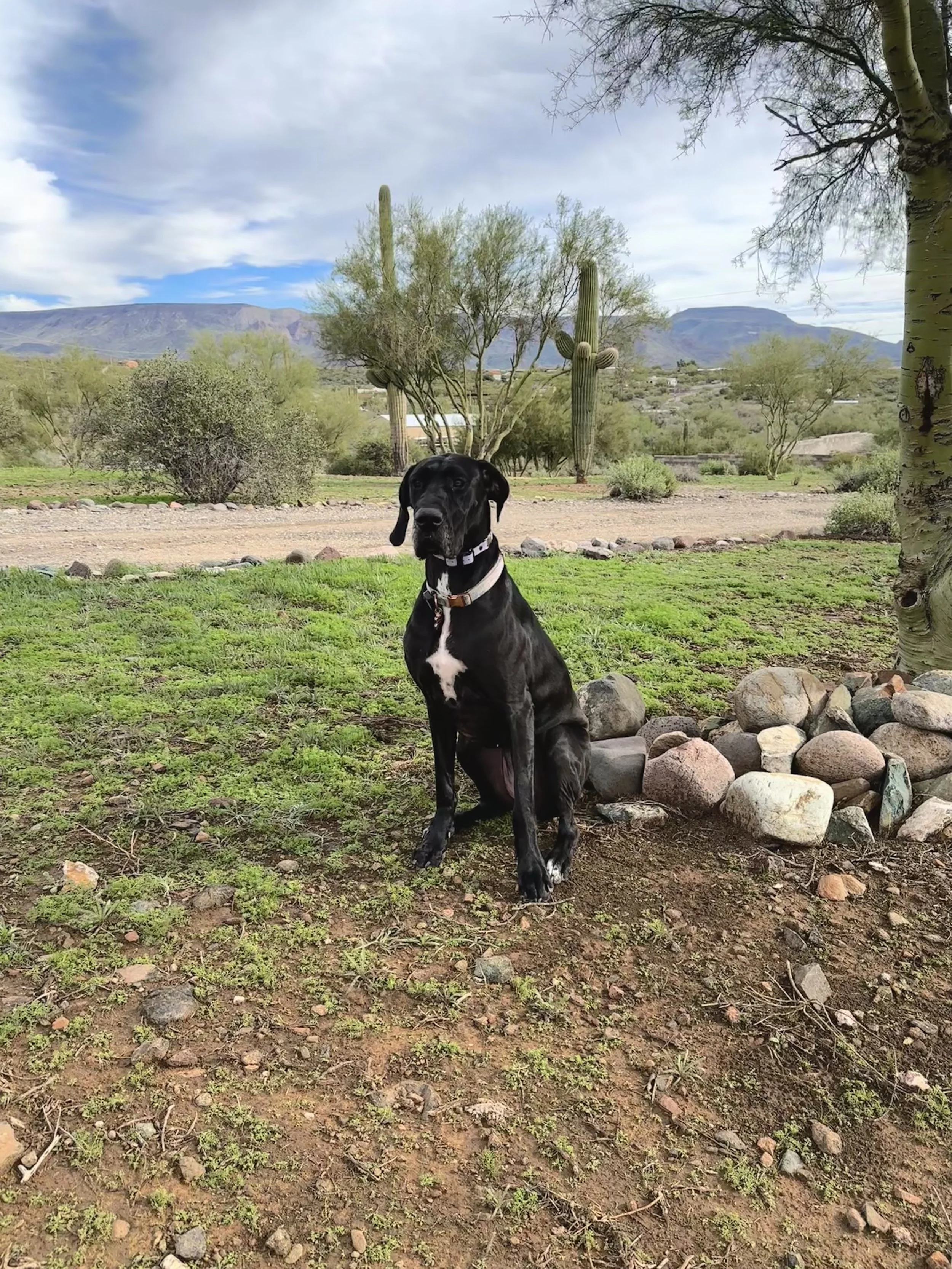
On Liberty
Liberty is our therapy dog. She is there whenever Christina is, and she is available to anyone who wants her in the room. She was a rescue. Christina kept the name the shelter had given her because it felt right.
There is real research on animal-assisted therapy and what it does to the nervous system. But the honest answer is simpler than that. Some things are hard to talk about. Some things are hard to even approach. And Liberty has a way of making the room feel safer than it did before she walked in, in a way that is hard to articulate but consistent enough that we have stopped trying to explain it and just accept that it is true.
Not everyone wants a dog in the room. That is fine. The point is that we thought about it, and we said yes, and that yes is a window into how we think about everything else.
What we are actually trying to build
Therapy, at its best, is not a service you purchase from an expert. It is a relationship in which two people are doing serious work together, one of whom has training and clinical skills, and both of whom are fully present.
The choices we make about the environment, about the walls, about the furniture, about who and what is in the room, are all attempts to make that relationship possible. To lower the threshold for trust. To signal, before a word is spoken, that this is a room where you do not have to perform.
We know our credentials. We did not need to put them on the wall to be good at what we do. And the people who need them to feel confident can look them up, any time, on the licensing board website.
What they will find when they walk in the door is something different. Which is exactly the point.
If you have been looking for a place that feels different from therapy you have tried before, we would love to talk.